
Sharing Rural Nebraska and Iowa Roads with Farm Equipment at Harvest
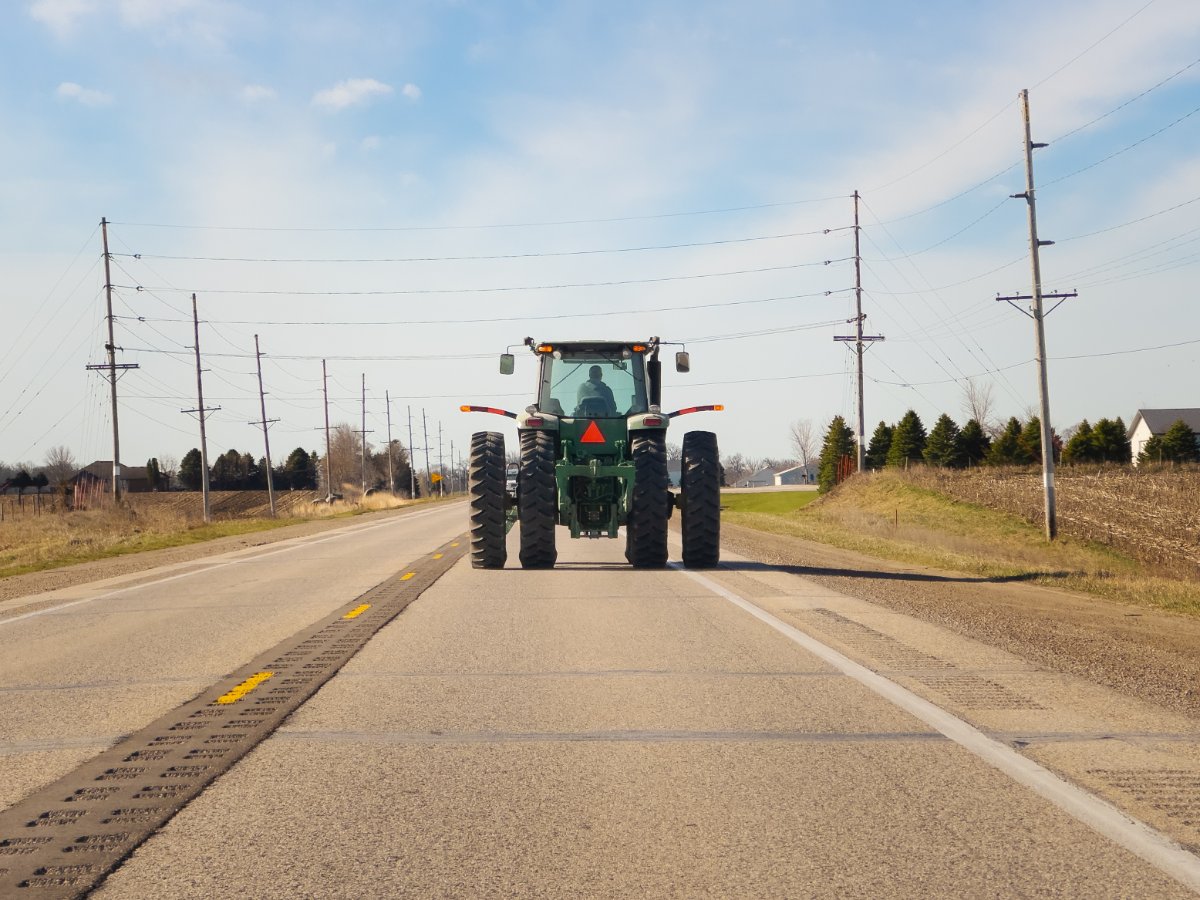 It’s 6:40 on an October evening on a two-lane highway west of Fremont. The sun’s sitting low and right in your eyes. You come over a rise doing 60, and there it is. A combine, wider than your lane, crawling along at 15 miles per hour with a header that hangs past the centerline.
Every fall, some version of that moment plays out on roads all over eastern Nebraska and western Iowa. Most of the time, drivers brake, slide in behind, and wait. Sometimes they don’t get the chance.
Harvest season runs roughly September through November here, and it changes who’s on the road. Tractors pulling grain carts. Combines moving field to field. Semis hauling corn and beans to the elevator. Omaha folks heading out to a pumpkin patch in Washington County or Harrison County, Iowa, often aren’t ready for any of it.
The math nobody thinks about
Speed difference is what makes these crashes so violent.
Say you’re doing 55 and the tractor ahead is doing 15. You’re closing that gap at about 59 feet every second. If you first spot the tractor 400 feet ahead, maybe because it’s just past a hill or a curve, you’ve got roughly seven seconds before you’re on its bumper. Take two of those seconds to realize it’s barely moving. Then react. That’s not a lot of room.
Add low autumn sun, dust kicked up off a gravel road, or a driver glancing at a phone, and seven seconds shrinks fast.
The two crashes we see most
There are two different types of crashes that are common during harvest. We see these cases frequently every fall.
The left turn into a field
This one causes some of the worst wrecks. A tractor slows down and drifts slightly right, which a driver behind reads as an invitation to pass. The truth is, the operator is swinging wide to make a left into a field entrance. The car pulls out to pass right as the tractor turns across its path. Side impact. Often at highway speed.
Who’s at fault? That depends. Did the operator signal? Were the turn signals even visible on that equipment? Was the driver passing in a no-passing zone or at an intersection? These cases rarely come down to one simple answer.
The rear-end collision at dusk
The other common pattern is a driver plowing straight into the back of slow equipment, usually in poor light. Missing or dirty slow-moving vehicle emblems, burned-out lamps, and equipment hauling attachments that block its own lights all show up in these cases more than you’d think.
What the law requires of farm operators
Farm equipment has every right to be on public roads. That right comes with rules.
In Nebraska, any vehicle designed for speeds under 25 mph has to display a slow-moving vehicle emblem on the back, under Neb. Rev. Stat. § 60-6,241. That’s the reflective orange triangle with the red border. The statute is specific: it has to be mounted two to six feet above the road and kept clean and reflective. And it doesn’t replace lights. It’s required on top of whatever lighting the law calls for.
Iowa has its own slow-moving vehicle and lighting requirements for implements of husbandry, found in Iowa Code chapter 321. Equipment traveling after dark is supposed to be lit and marked so approaching drivers can recognize what it is and how slow it’s going.
Here’s what we look at after a crash. Was the emblem there? Faded to pink after years in the sun? Hidden behind a grain cart? Were the hazard lights flashing? Did the equipment have to cross the centerline, and if so, was there a pilot vehicle or escort? A missing or useless emblem can be powerful evidence of negligence.
Fault isn’t automatic, either way
Drivers sometimes assume the farmer is always at fault because the equipment was in the way. Insurers sometimes assume the driver is always at fault because they hit something slow. Neither assumption holds up well.
Both states compare fault. In Nebraska, a jury trims your award by whatever share of the blame it assigns you, and hitting 50% compared to the total fault of those you’re seeking recovery from shuts the door on recovery. Iowa’s rule is a little different. You’re barred only if your fault is greater than the combined fault of the defendants and other parties included in the fault calculation. Either way, the percentages matter, and that’s why the evidence matters so much.
Who pays after a farm equipment crash?
Determining who pays after a farm equipment crash can become complicated very quickly. Some of the possible sources:
- The farm operator’s insurance. Many tractors and combines aren’t covered under a standard auto policy. Coverage often runs through a farm liability policy instead, and those policies can have their own terms and exclusions.
- The farm or business behind the equipment. If a hired hand or family member was driving for the farm, the farm itself may be responsible.
- A custom harvest crew. Plenty of harvesting gets done by outside crews moving from farm to farm. They’re typically commercial operations, with commercial coverage.
- The equipment manufacturer. If poorly designed lighting or a defective part played a role, a product claim may be possible.
- The county or state. Hidden intersections, missing signs, overgrown sightlines. Claims against government entities can carry much shorter notice deadlines, so they can’t wait.
- Your own coverage. Underinsured motorist coverage can help when the at-fault party’s policy isn’t enough.
With so many possibilities, it’s important to have a skilled attorney on your side to help you determine every possible source of recovery.
When a harvest crash is fatal
Farm equipment crashes kill people every year in both states, drivers and operators alike. When that happens, the family may have a wrongful death claim. In Nebraska, it’s brought by the personal representative of the estate and generally must be filed within two years. Iowa has its own wrongful death and estate rules, also on a tight timeline. We know how heavy this is. We also know evidence like equipment condition and crash data doesn’t wait for families to be ready.
FAQs
What should I do after a crash with a tractor or combine?
Call 911 and get medical care first. If you can, photograph the equipment from behind, including the slow-moving vehicle emblem, lights, and anything hanging past the centerline. Get the operator’s name and the farm or company they work for. Then talk with a lawyer before giving the farm’s insurer a recorded statement.
Can a farmer be held responsible for a crash on a public road?
Yes. Farm operators have a duty to drive their equipment reasonably and to follow lighting and marking rules. Missing emblems, dead lights, unsignaled turns, or equipment taking up the whole road without a required escort can all point to the operator, and sometimes to the farm or harvest crew they work for.
Is it legal to pass farm equipment in Nebraska?
Generally, yes, when it’s safe and legal to pass. That means a clear line of sight, no double yellow line, and not passing at or near an intersection. Avoid passing near field entrances, too. Watch for signs that the operator is about to turn left, since swinging wide is common with large equipment.
Can I recover if I share some blame for hitting farm equipment?
You may still recover. Both Nebraska and Iowa reduce your damages by your share of fault. In Nebraska, you’re barred if you’re 50% or more at fault. In Iowa, you’re barred only if your fault is greater than the combined fault of the defendants and other parties included in the fault calculation. Evidence about lights, emblems, and visibility often shifts those percentages.
Hurt in a harvest crash? Call IKCS
Since 1960, Inserra Kelley Cooper Sewell has handled crash cases across Nebraska and Iowa, from I-80 interchanges to gravel section-line roads. We go to the scene. We look at the equipment, the lights, the emblem, the sightlines, and the insurance behind every party involved, and we build each file to be ready for trial. Healing first, then results. There’s no fee unless we win, and your first conversation is free. Contact us now, while the evidence is still out there.